
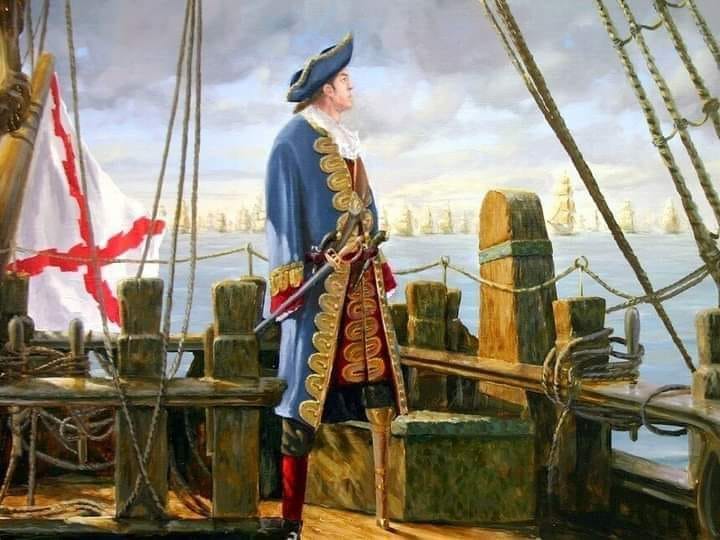


From March 13 to May 20, 1741, the Battle of Cartagena de Indias (present day Colombia) took place between the Spanish and British forces. This battle was decisive for the final outcome of the War of Jenkins’ Ear (1739–1748), one of the many armed conflicts between Spain and Great Britain that occurred during the 18th century.
This new British Invincible Armada of 195 ships was larger than Felipe II’s of Spain, and the second largest of all time, after the Allied Armada that landed in Normandy in World War II. The British forces, commanded by Admiral Edward Vernon, tried to invade Cartagena de Indias with 32,000 soldiers and 3,000 artillery pieces. Cartagena was defended by 3,600 soldiers and 6 Spanish ships. Leading its defense was Admiral Bas de Lezo, “the Half Man”, one of Spain’s most gallant naval commanders, who had lost a leg, an arm, and an eye in a distinguished fighting career. He had only six ships of the line to face the British armada, but had no intention of giving in. Britain was so sure of its victory that King George II had coins minted celebrating his triumph, which read «Spanish arrogance humiliated by Admiral Vernon and British heroes took Cartagena, April 1, 1741» and Blas de Lezo appeared represented on his knees handing over his sword to Admiral Vernon, a very complete Lezo with all his legs, arms and possibly eyes … incredible, right? What actually happened was the biggest and most humiliating defeat in the entire history of the Royal Navy, as it lost 50 ships and 11,000 men at the hands of a garrison made up of only 6 ships and 3,600 Spanish defenders led by the Spanish Admiral Blas de Lezo! 
The victory of the Spanish forces, commanded by Admiral Blas de Lezo, prolonged Spanish military supremacy in the western Atlantic until the 19th century. 
(Publicado por Cliff Page)Museo Hispano de la Revolución AmericanaDel 13 de marzo al 20 de mayo de 1741, la batalla de Cartagena de Indias tuvo lugar entre las fuerzas españolas y británicas. Esta batalla fue decisiva para el resultado final de la Guerra de la Oreja de Jenkins (1739-1748), uno de los muchos conflictos armados entre España y Gran Bretaña que ocurrieron durante el siglo XVIII.Esta nueva Armada Invencible Británica de 195 barcos fue más grande que la de Felipe II de España, y la segunda más grande de todos los tiempos, después de la Armada Aliada que aterrizó en Normandía en la Segunda Guerra Mundial. Las fuerzas británicas, al mando del almirante Edward Vernon, trataron de invadir Cartagena de Indias con 32.000 soldados y 3.000 piezas de artillería. Cartagena fue defendida por 3.600 soldados y 6 barcos españoles. Liderando su defensa estaba el almirante Bas de Lezo, «el medio hombre», uno de los comandantes navales más valientes de España, que había perdido una pierna, un brazo y un ojo en una distinguida carrera como luchador. Solo tenía seis barcos de línea para enfrentarse a la armada británica, pero no tenía intención de ceder. Gran Bretaña estaba tan segura de su victoria que el rey Jorge II tenía monedas acuñadas celebrando su triunfo, que decía «La arrogancia española humillada por el almirante Vernon y héroes británicos tomaron Cartagena, 1 de abril de 1741» y Blas de Lezo apareció representado en su rodillas entregando su espada al almirante Vernon, un Lezo muy completo con todas sus piernas, brazos y posiblemente ojos… Increíble, ¿verdad? Lo que realmente sucedió fue la derrota más grande y más humillante en toda la historia de la Royal Navy, ya que perdió 50 barcos y 11.000 hombres a manos de una guarnición compuesta por sólo 6 barcos y 3.600 defensores españoles encabezados por el Almirante español B ¡Las de Lezo!La victoria de las fuerzas españolas, comandadas por el almirante Blas de Lezo, prolongó la supremacía militar española en el Atlántico occidental hasta el siglo XIX.